Kim Oliveros
Neil de la Cruz
Rocelie Delfin
Kim Oliveros
Neil de la Cruz
Rocelie Delfin

GROUP SHOW
Collector's Choice


LYRA GARCELLANO
Heavy Lifting


Lyra Garcellano’s solo exhibition, Heavy Lifting, presents a series of paintings which explore the intersections of colonialism, labor, gender, and the politics of representation. For her paintings, Garcellano references specific 19th and 20th-century photographs of Filipino women. Concentrating on photographs from this era, the artist examines the nation’s colonial history and how photography, a then-nascent technology of vision, served the interests of the ruling classes.
The photographs used by the artist all depict women carrying woven baskets, clay pots, flowers, and various wares on their heads. On the surface, this practice can be wholly attributed to the inaccessibility of more efficient methods of transporting objects. However, this obscures the role that colonial and imperialist powers have played, and continue to play, in forcing millions into poverty and keeping other areas around the world in a state of underdevelopment, hence the practice’s prevalence in the present age.
The timeframe selected by the artist covers the bloody transition from the Spanish to the American period, from the domination of an old colonial regime to that of a then-rising imperialist power. This period also encompasses the emergence of semifeudalism in the country—a ruthlessly exploitative system that persists to this day in which the centuries-old feudal mode of production is perpetuated and subsumed under imperialism (i.e. monopoly capitalism, chiefly that of the US). This serves as the context surrounding the materials that Garcellano had gathered—an atmosphere of struggle and bloodshed that, while not readily evident in the photographs, nonetheless permeates the images and is brought to the surface by the artist.
The exhibition seeks to demystify the aura of scientific objectivity that photography possesses. It highlights how the selected photographs did not simply and “neutrally” capture or reflect “reality” but also produced realities beneficial to the colonial forces by reinforcing colonizer-subaltern power relations. Photography was one among many tools utilized by our colonizers in propagating their ideology and asserting their cultural hegemony, all to facilitate the further extraction of our resources and oppression of our people and thus bolster their political and economic power.
Garcellano highlights how these images—captured by Europeans/Americans, for European/American audiences—were directed by a colonial gaze, one that presents Filipino women not as humans with agency but as “backwards” and “primitive,” as both “savages” in need of “civilizing” and as “exotic” sights to behold. These identities, shaped by the racism and sexism of outsiders, were instilled in the local populace, which worked to pacify them and stifle dissent. So not only do the photographs gloss over the hard physical labor exerted daily by its subjects, romanticize poverty, and conceal the role of colonialism and imperialism in generating economic crises, but they help shape and strengthen perceptions of ourselves in ways that serve (neo)colonial sociopolitical and economic interests.
Through the act of painting, the artist mediates and reappropriates these photographs and subverts the hierarchies latent in them. Each painting presents the female figures as silhouettes bearing vibrantly colored floral designs against monochromatic environments. This is an attempt at bringing female colonial subjects—often relegated to the background, to blend into and become mere features in an idyllic, tropical scene—to the foreground and emphasizing their presence, existence, and labor. In Garcellano’s series of paintings, color and pattern are intended to symbolize layers of meaning and provide depth to the presentation of these figures, to revitalize them and give them a second life, in stark contrast to the frozen and passive states found in the original posed photographs.
Garcellano’s use of the idioms of decoration, ornament, and craft calls to mind the arguments made by artists Valerie Jaudon and Joyce Kozloff in “Art Hysterical Notions of Progress and Culture” (1978). In the essay, they explore the prejudice against the decorative and a “disturbing belief system based on the moral superiority of the art of Western civilization” which relies on various constructed hierarchies: fine art above decorative art, Western art above non-Western art, and men’s art above women’s art. The authors note the machismo of various men in the history of modern art and their tendency to describe their art, if not as metaphorical weapons in contradistinction to decoration, as couched in terms with strong connotations of violence. Instead of omitting the violent so as to exalt the decorative, Garcellano retains this imposed contradiction and inverts it, privileging the exuberantly ornamented, colonized female laborer against a nebulous backdrop of colonial violence rendered in grisaille.
The subject matter Garcellano chose for her works, while historical, remains relevant today as it illustrates an ongoing narrative not simply of “underdevelopment” but, as the late political scientist Michael Parenti argues, of “overexploitation”. Colonies and semi-colonies like the Philippines continue to be blocked by imperialist powers like the US from enacting genuine land reform and national industrialization so as to remain both as sources of cheap raw materials and labor-power and as dumping grounds for surplus commodities and capital. Indeed, within the global capitalist system, there would be no economic powerhouses like the US without colonies and semicolonies which they could exploit. Land is being converted away from the production of food and necessities towards various non-productive purposes designed to draw in foreign investments. Locals in tourist spots engage in self-exoticization and fuel the imperial imaginary to make ends meet, while indigenous communities are brutally displaced from their ancestral lands to make way for foreign mining projects.
Photography and other media technologies continue to be used to serve the sociopolitical and economic interests of the imperialist, comprador, and landlord classes. Heavy Lifting engages with this politics of visibility, encouraging a heightened sensitivity to the power of images and their capacity to (re)produce macho-feudal, colonial, and imperialist fantasies, and celebrates painting as a process of reconfiguring and materializing new visual forms and identities.
-Dominic Zinampan
KATHLEEN G0BASCO
Hiding from Gaze


In her solo exhibition Hiding from Gaze, Kathleen Gobasco centers vulnerability as a condition of being seen—particularly in that small, unsettling moment when the one being observed suddenly becomes aware of the gaze upon her, and with it, the possibility of being assessed, judged, or exposed. Across a suite of six works rendered in graphite on canvas, Gobasco attends to gestures that seem almost incidental: a pair of hands caught in the act of closing a curtain; hands suddenly clutching a blouse along the button line. These are ordinary movements, but in the presence of an unwelcome gaze, they acquire an urgency that is at once intimate and defensive.
Such acts foretell the sudden presence of a stranger, someone whose arrival is not necessarily announced but whose gaze immediately alters the character of a private space. The curtain is drawn. The body is covered. Privacy, which had previously required no defense, must now be actively protected. In this reversal, the gravity of the situation shifts toward the one looking. The gaze, once unnoticed, is exposed as voyeuristic; the observer becomes aware of having trespassed into a space where access was never granted. What follows may be discomfort, embarrassment, even shame.
In another suite of works, Gobasco presents studies of hands partially concealed by a box. In one, the concealment is complete; in another, the box is fully open, with the hands appearing to reach toward each other. Here, hiding and revealing become less clearly opposed. The same gesture that protects can also become a gesture that reaches out. Concealment does not necessarily mean withdrawal, just as exposure does not necessarily mean surrender.
Hiding from Gaze dwells on that instant when peace is unsettled by the awareness of the other: the realization that another person, as stranger, has no inherent access to what lies within—the interior of a room, the covered surface of the body, or the private territory of the self. The impulse to hide may arise from fear, from a need for protection, or from a more deliberate assertion of autonomy. Gobasco finds this condition not in grand acts of resistance but in the tiny gestures through which we negotiate our presence in the world: drawing a curtain, fastening a button, covering the body, withdrawing the hand.
-Carlomar Arcangel Daoana
KIM OLIVEROS
Night Walks
%20.jpg)


“Yet the green trees
With their long-striding roots
Are keeping pace with me here.”
-from Jaroslav Seifert’s poem “How painful I would find it…”
The act of wandering is a search for refuge. There is a sense of rest in aimlessness, a way of grounding oneself and, perhaps, resisting external forces that demand productivity. While Kim Oliveros experiences the pressures of artistic production, he acknowledges that a sense of aimlessness is essential for re-centering and recalibrating the self, much like the comfort found in taking long walks at night without a predetermined destination.
Oliveros builds upon his previous exhibitions, capturing impressions of his surroundings, particularly the changing landscapes of his hometown of Angono, Rizal. Through layered imagery and three-dimensional elements in his paintings, he documents places that have gone through transformations over time, while, in Oliveros’s own words, attempting to preserve places, emotions, and moments that continue to shape him. For instance, the bird sculpture is inspired by a species of bird locally known as layang-layang (swallows) which is said to be endemic to Angono but was displaced following the reclamation of parts of the town’s lake.
In his installation comprising over a hundred sculptures, Oliveros uses the motif of birds to evoke memories of his early years as a flutist in a marching band in Angono. The title of the work, Uwido, is derived from the Spanish word oido, which roughly translates to “innate musicality.” Suspended by wires, the bird sculpture incorporates bells that produce a subtle sound as it moves. However, Oliveros situates the work in a more local and personal context, referencing his marching band’s practice of uwiduhin, meaning to play music from memory or by feeling.
In every show, the artist pairs his paintings with sculptural representations of flowers and insects, and, in the current exhibition, birds. His background in making sculptures was shaped by a brief stint painting finishing details on figurines manufactured for export, suggesting that his artistic inclinations are not incidental but rather long embedded in his consciousness.
In Night Walks, the familiar images of a landscape in his work are revisited and reinterpreted through his recent reflections he gathered from his nighttime walks. To reimagine a place that holds meaning in our lives is to recognize it despite the changes brought by time. Oliveros is not only a witness to how past and present landscapes have transformed; through his work, one can begin to imagine a landscape, possibly one that is not bound by time. (James Tana)
YASMIN CRISOSTOMO
Forever Blooms
.jpg)


An Artist’s Philosophy
For Yasmin Crisostomo, flowers are nature’s purest expression of beauty—delicate, fleeting, and profoundly alive. Her paintings arise from a desire to preserve what is ephemeral, capturing in watercolor the brief perfection of a bloom before it fades. The sentiment expressed in Thomas Gray’s celebrated line, “Full many a flower is born to blush unseen…”, finds a natural resonance in her work. Through her art, she invites viewers to pause and contemplate the quiet splendors of the natural world.
Yasmin’s distinctive palette is deeply informed by her lifelong career as a jeweler. Having spent decades immersed in the world of precious gemstones, she brings to her paintings an extraordinary sensitivity to color and light. The radiant pinks of tourmalines, the regal purples of amethysts, and the crystalline blues of aquamarines suffuse her floral subjects with a jewel-like luminosity. Her flowers do not merely depict nature; they celebrate it through the lens of preciousness and wonder.
Her affinity for flowers is also personal. Named Yasmin—the Arabic form of jasmine—she has long felt a special connection to the floral world. This connection lends her work an intimacy that transcends botanical illustration, transforming each flower into a meditation on beauty, memory, and the passage of time.
Watercolor is the ideal medium for her artistic vision. Fluid, organic, and inherently unpredictable, it mirrors the very qualities that define the flowers she paints. The transparency of watercolor allows light to permeate the image, creating a luminosity and freshness that cannot easily be achieved in other media. Embracing both its discipline and its spontaneity, Yasmin allows the medium to flow and surprise, often revealing moments of unexpected beauty.
In these works, flowers become more than botanical subjects. They are vessels of memory and light, rendered in jewel-toned hues and suspended, however briefly, against the passage of time. Through her paintings, Yasmin Crisostomo transforms the fleeting into the enduring, inviting viewers to experience the timeless beauty that resides within even the most transient bloom.
-Yasmin Crisostomo
GINO BUEZA
Half Full Half Sorry


Painting can be beautiful yet also agonizing. It is a container, a receptacle of your daily
routine, ideas, mistakes, and muscle memory hoping they would somehow congeal into
a language that you form in the studio. In the process, you begin to stutter and end in
glossolalia - chasing where a line could lead, what a dot could be, what shape might
emerge. But what is it then that you’re chasing?
Expanding his assembly line of materials and quips, at full display is Gino Bueza’s
lexicon at work: the juxtaposition of print and paint, layered with color and gestures,
“Half Full Half Sorry” gives us a front seat into an experience of how it feels like when
you stop and finally try to catch your breath. A breath that becomes a moment, an
opportunity to pause, to notice, to be aware, to live, and not take life too seriously. An
invitation to stay curious, look closer, step further, and see things in more ways than
one.
The artist approaches the process of painting “with eyes closed and an open heart”
where jitters and false starts eventually “dissolve into a string of curiosities and
unfiltered decisions.” It becomes “a quest, filled with hopes, looking for a certain feeling,
never about its meaning.” A reminder that to create something takes courage.
Repeating itself but never like so are pattern-printed grids set against stark contrasts of
colored bands and shapes and overlaid with collage elements standing out underneath
layers of translucent washes maximized within a series of large canvases like “Little
ants carrying big things.” There is an overlap or “layering contrasts of fluidity and
flatness,” a reconfiguration of sorts happens as rhythm catches the artist working. This
rhythm is then caught in shifting states as each small, yet intimate canvas work
becomes an integral part of the artist’s practice like meditative journal entries and as
screenshots that over time accumulate “as traces paired with overlapping chances and
decisive actions” are subconsciously added into an even more extensive visual
vocabulary.
Intersecting across the canvas, silhouettes of brushes and fishes fill the space as Yin is
to Yang, as they emerge from the mind’s eye. Referencing how ideas are like fish
waiting to be captured, describing the creative process swimming in different directions
that create ripples from one canvas to the next following the ebbs and flows of one’s
intuition.
Lifted from the term and halted within the bounds of the canvas, in “Air Quotes (AB-EX)”
we see bold balloon shaped letters form Bueza’s text play, using AB-EX in a tongue-in
cheek way abbreviated from Abstract Expressionism, inverted as EX-AB or perhaps to
be deconstructed, interrupted by a translucent overlay of colored digital typeface
cascading like Tetris pieces that fill the space. The spaces within each painting are
intuitively yet decisively filled by unique picture elements or what’s commonly known aspixels whether made from a screenprint, a stencil, or an ice cube tray which also
doubles as the artist’s mixing plate with each creating a unique pattern or configuration.
Squint and perhaps you’ll see things more clearly. Swipe left or take a step back and
ask yourself again. The works in the exhibit become a metaphor for breathing. The
various dimensions in scale, the maximal and minimal, we breathe in and breathe out.
What then gives more meaning to the fullness would be its counterpart wherein sorry
isn’t a placeholder for empty but becomes something that is acknowledged rather than
rejected. Bold and unapologetic. Sorry, not sorry.
-Mai Saporsantos
YASMIN CRISOSTOMO
Forever Blooms
An Artist’s Philosophy
For Yasmin Crisostomo, flowers are nature’s purest expression of beauty—delicate, fleeting, and profoundly alive. Her paintings arise from a desire to preserve what is ephemeral, capturing in watercolor the brief perfection of a bloom before it fades. The sentiment expressed in Thomas Gray’s celebrated line, “Full many a flower is born to blush unseen…”, finds a natural resonance in her work. Through her art, she invites viewers to pause and contemplate the quiet splendors of the natural world.
Yasmin’s distinctive palette is deeply informed by her lifelong career as a jeweler. Having spent decades immersed in the world of precious gemstones, she brings to her paintings an extraordinary sensitivity to color and light. The radiant pinks of tourmalines, the regal purples of amethysts, and the crystalline blues of aquamarines suffuse her floral subjects with a jewel-like luminosity. Her flowers do not merely depict nature; they celebrate it through the lens of preciousness and wonder.
Her affinity for flowers is also personal. Named Yasmin—the Arabic form of jasmine—she has long felt a special connection to the floral world. This connection lends her work an intimacy that transcends botanical illustration, transforming each flower into a meditation on beauty, memory, and the passage of time.
Watercolor is the ideal medium for her artistic vision. Fluid, organic, and inherently unpredictable, it mirrors the very qualities that define the flowers she paints. The transparency of watercolor allows light to permeate the image, creating a luminosity and freshness that cannot easily be achieved in other media. Embracing both its discipline and its spontaneity, Yasmin allows the medium to flow and surprise, often revealing moments of unexpected beauty.
In these works, flowers become more than botanical subjects. They are vessels of memory and light, rendered in jewel-toned hues and suspended, however briefly, against the passage of time. Through her paintings, Yasmin Crisostomo transforms the fleeting into the enduring, inviting viewers to experience the timeless beauty that resides within even the most transient bloom.
-Yasmin Crisostomo
VALERIE CHUA
A Record of Looking


In an age defined by the relentless production and circulation of images, Valerie Chua turns her attention toward those that seem to belong to no one in particular. Drawn from the vast and ceaseless accumulation of visual culture, the images in this exhibition are selected precisely because they bear no personal affiliation to the artist. They become a test of looking itself: what happens when observation is directed toward images stripped of attachment, memory, or biography?
Having chosen them, Chua subjects these fragments of visual culture to the concentrated labor of painting. The process is neither straightforward translation nor faithful reproduction. Through careful acts of selection, emphasis, omission, and cropping, she determines where attention should settle and where it should falter. Some images are truncated; others remain deliberately unfinished. Such gestures mirror the conditions from which these images emerge—detached from context, severed from narrative, encountered as isolated visual events whose origins remain inaccessible.
Yet detachment does not result in coldness. If anything, Chua pursues the emotional residue that images carry despite their anonymity. Through passages of hypersaturated color and luminous surfaces, the paintings evoke a peculiar nostalgia untethered from lived experience. They seem suspended within a vacuum of time, recalling memories that may never have belonged to us in the first place. At moments, the works appear as though they are still coming into being, as if the images are developing before our eyes and have not yet settled into fixed form.
Installed together, the paintings resist continuity. They do not cohere into a singular story or thematic sequence. Instead, they offer a series of visual ruptures: a family photograph with the mother's head abruptly cut off, a dead bird, and other seemingly ordinary images that oscillate between familiarity and estrangement. Meaning emerges not through narrative connection but through the gaps that separate one image from another.
Painting has long carried the assumption that its subjects are chosen out of personal significance—that the artist paints what matters to them. Chua unsettles this expectation. Rather than approaching her subjects through intimacy or identification, she adopts a position of deliberate remove, allowing the discipline of painting to encounter images outside her immediate sphere of interest. In doing so, the paintings become meditations not on the subjects themselves but on the condition of imagehood. These anonymous fragments of visual culture, detached from origin and ownership, become the objects of the artist's sustained and unreserved devotion.
-Carlomar Arcangel Daoana
GERICHO LAYANTE
Imahinasyon at Inspirasyon: Kanlungan ng Gunita


When Gericho Layante finishes and sees his works, he can’t imagine how he was able to come up with these kinds of works. He used to have a hard time making them. In his show entitled Imahinasyon at Inspirasyon: Kanlungan ng Gunita, he combines imagination and inspiration. Imagination and inspiration motivated him to make his works. The imagination of his work is the characteristics of the cartoons, which play in his mind while he watched people in the bukid, back in the province. Inspiration comes from his amazement with his idol Fernando Amorsolo, who serves as his light while he paints.
The show is about going back to childhood and memories of a simple yet happy life in the province. The works’ colors show the beauty of childhood, from playing under trees, the neighbor’s conversations, and life near the environment. His works show a time when one doesn’t think of the heaviness of the world. The colorful characters and their elements come from the imagination. They show how childhood shaped Gericho’s views and dreams. The mix of reality and fantasy symbolize the innocence of the thoughts of a child who grew up in the province. A world full of color, questions, and never ending imagination.
Gericho’s painting process starts with thinking of a concept coming from life in the province of Batangas, where he grew up. He also thinks about Amorsolo’s works and the cartoon characters. These are included in the concept of the artwork. He starts drawing on scratch paper and once he comes up with a concept he draws on canvas. He continues his work with the underpainting technique.
He uses oil paint and a canvas to paint because he mastered using these mediums. His works took inspiration from Fernando Amorsolo who Gericho idolizes ever since he started painting. With the help of his college professor, he was able to find his art style. His style is inspired by Amorsolo’s works, fun cartoons that play in his mind, his experiences since his childhood in the province, his dream of becoming a painter, and the farmers and people from the province.
-Mica Sarenas
JAY TICAR & AMY ARAGON
Breathe the Pressure


In Breathe The Pressure, Jay Ticar and Amy Aragon turn to a condition that is at once proximate and removed: the experience of war as it is mediated to those who are not directly within its field, yet remain subject to its psychological and emotional aftershocks. Rather than documenting conflict, they attend to how its reverberations are absorbed—through news cycles, images, and the steady accumulation of unease that follows. What is foregrounded is the internal adjustments that war compels: the subtle, persistent shifts in how one locates the self in relation to distant violence.
Across the exhibition, the pictorial field operates less as a site of representation than as a surface of registration. Instability becomes structural. In Ticar’s works, color and form gather in dense, polychromatic arrangements that suggest a continuous state of agitation. Aragon, by contrast, works with restraint, her muted palette and reduced compositions articulating a quieter but equally tenuous equilibrium. These divergent approaches do not oppose one another so much as establish different registers of the same condition—one expansive and accumulative, the other pared down to its most fragile elements.
Aragon begins with family photographs, images that ordinarily carry a presumption of coherence and continuity. She subjects them to a process of filtering—both material and conceptual—that introduces ambiguity into their meaning. The images are interrupted, overlaid with forms that suggest particulate matter or enclosed atmospheres, at times evoking the uterine, at others a state of suspension. These interventions draw the image away from straightforward recognition and toward abstraction, where it hovers between preservation and erasure.
Ticar’s work engages a different tension, bringing together architectural structure and apparent disorder. Beneath the density of his surfaces are underlying frameworks—grids and spatial cues—that organize, even as they are tested by the surrounding flux. His interest lies in what form of coherence might still be sustained within such conditions. Geometry here does not assert dominance over chaos; it persists alongside it, offering a provisional measure rather than a final order.
At the center of the exhibition is a Zen garden-like installation composed of crushed charcoal. Its dark, striated surface suggests both residue and reconfiguration, a landscape formed from what has been broken down. The artists propose an analogy to vinyl records, where the grooves hold the traces of what has been inscribed, and the subject becomes the needle that moves across them. The work introduces a spatial pause, but not a withdrawal; it frames contemplation as part of an ongoing process of negotiating aftermath.
Abstraction, in this exhibition, is not positioned as a retreat from the realities of conflict. Rather, it acknowledges that such realities are often encountered indirectly, and are processed in ways that resist clarity. Ticar and Aragon work within this space of indeterminacy, where responses are partial, unsettled, and continuous. The exhibition suggests that to register these conditions—however incompletely—is already to recognize the extent to which lives, even at a distance, remain implicated in the pressures of conflict.
-Carlomar Arcangel Daoana
HIKARI
Rise of the Final Guerlz


In Rise Of The Final Guerlz, Hikari gathers a small army—sixty toy sculptures that at once recall and revise the figure canonized by film studies theorist Carol J. Clover: the “final girl,” that lone survivor of the slasher film who, bloodied yet unextinguished, emerges as the narrative’s last witness. Traditionally singular, this figure is here multiplied, dispersed into a field of presences. Hikari’s “final guerlz” do not stand apart—they stand together.
Rendered in a stark, receptive white, these figures function less as fixed identities than as surfaces of becoming. They are projection spaces—objects that hold, rather than dictate, meaning. In their quiet uniformity lies a latent invitation: to see oneself among them, to inhabit their stance of endurance. Hikari speaks of increasing the number of final girls in the world. The sculptures accumulate into a collective body, an insistence that survival is not anomalous but shared, not exceptional but recurrent. Their presence is both companion and confirmation—an assurance that one does not persist alone.
At the exhibition’s center, “Engines of Destruction” interrupts this quiet proliferation with a more charged, ambiguous object. A found form, recontextualized, it extends its prior life by submitting to a new narrative logic. Enclosed, contained, it carries the aura of something volatile—its coiled structure faintly recalling the double helix, that intimate architecture of life itself. Whether read as a residue of post-pandemic anxiety or as a meditation on the unseen forces that structure existence, the work hovers between menace and meaning, its containment suggesting both protection and fear.
Elsewhere, Hikari’s frottage drawings register the city through touch. By pressing and lifting textures from the streets, she constructs a cartography that is at once tactile and speculative—a map not of coordinates but of contact. In these works, Vancouver and Manila begin to converge, their surfaces translated into a shared visual language. The streets of one city echo in another, suggesting that urban experience, like survival itself, is threaded by unseen continuities.
This expanded field of images and objects finds resonance in the video work “Ding ang Bato,” where the “final guerl” steps fully into lived reality. Here, she is not a cinematic trope but a symbolic condensation of real women—those who endure war, illness, rupture, and the quieter violences of daily life. She appears in multiple guises: teacher, artist, leader, neighbor. What binds these figures is to move through and beyond adversity without erasure.
In this light, Rise Of The Final Guerlz becomes less an homage to a genre than a reorientation of its central figure. The “final girl” is no longer the last one standing because all others have fallen; she is one among many who continue to stand. Hikari transforms survival from an endpoint into a shared condition, from a solitary climax into an ongoing, collective act. What emerges is not a singular heroine, but a constellation—each figure bearing witness, each one carrying forward the possibility that endurance, once claimed, may also be passed on.
-Carlomar Arcangel Daoana
BEMBOL DELA CRUZ
In Plain Sight


In his solo exhibition, In Plain Sight, Bembol Dela Cruz reconsiders camouflage beyond its militaristic roots, using it instead as a way to think about how individuals move within larger social and political environments. Here, camouflage is less about concealment in battle and more about the everyday act of blending in—of adjusting oneself in response to shifting contexts and expectations.
At the center of the exhibition is a self-portrait: the artist dressed entirely in camouflage, from hat to shirt to pants. The figure seems to recede into its surroundings, yet a pair of Sneakers interrupts this near-erasure. The choice feels deliberate. Even in the act of blending in, there remains a trace of individuality—something that resists full assimilation, something that insists on being noticed.
While the work may appear autobiographical, it resists a straightforward reading. The artist allows himself to be recognized, but not fully known. There is a measured withholding at play, as if to suggest that identity is never entirely given over to the viewer. Instead, it is carefully managed—revealed in parts, concealed in others. In this way, the work underscores a quiet assertion: that the artist retains control over how he is seen.
As the artist notes, individuals have the ability to navigate between presence and absence, to turn certain aspects of themselves on or off depending on the situation. At times, this negotiation may be a matter of survival. Yet within the neutral space of the canvas, camouflage does not disappear as intended. It becomes visible, even unavoidable, carrying with it echoes of its history—of conflict, of occupation, of systems that once relied on it for dominance.
Across the exhibition, Dela Cruz takes on the role of a camoufleur, responsive to his environment and attentive to what is revealed or withheld. The works resist a complete or fixed reading, suggesting instead that the self is always in flux—shifting, adjusting, and at times slipping from view. In In Plain Sight, visibility is never absolute, and identity asserts its presence precisely through its capacity to elude.
-Carlomar Arcangel Daoana
AYO
Painting After Surfing
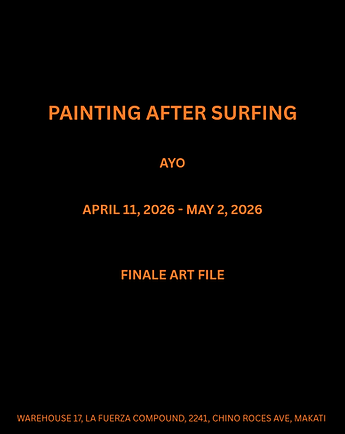


Surfing the home break waves in La Union is still the main inspiration for these
recent paintings and it became a program for my work, the art making process is just to flow in and out, or drive the intensity and complexity of something whatever the consequences. How do you represent something that has no consistent form? It’s like riding the swell with an 8’0 or a 9’0 log with a similar froth to paintbrush strokes.
The two diverse paths, Surf and Paint, Paint and Surf go hand in hand and you would only be able to elucidate their principles by doing it. Each WAVE is different and painting relates to it in a sense. The purpose, pattern, or structure, often occurring by coincidence. Yeah, it also refers to the size, position, shape, or arrangement within a space.
I can’t really explain the stoke here,
It’s just
PAINTING AFTER SURFING
is an experience.
On another level,
It is an access to a “spatial depth”.
-AYO
ANDRE BALDOVINO
Biomes


Biomes dissects the logic of Andre Baldovino’s artmaking process. He frames the exhibition as a manual for understanding his practice by rendering it legible in exercises in reconfigurations. Symbolically conceiving them as “biomes,” the present works are akin to worlds conjured from a machinery of objects, formal elements, and ideas—engineered according to principles that bisect art and biology, and ultimately demonstrating the significance of negotiations in his worldmaking.
Baldovino prefaces the exhibition with 36 glass containers occupying three shelving units. Fashioned after aquariums or terraria, they emerge as the primary illustrative device of his creative process; the works were assembled through a logic that mimics procedural generation in video game maps, where an algorithm is instructed to generate seemingly infinite content out of a finite inventory of assets and code. While this process may initially appear as exclusively mathematical or formulaic, spontaneity comes into play when the program randomizes the combinations and through the human player’s decisions made in-game. From these, two salient points may be observed: (1) the tendency to negotiate competing imperatives (e.g. infinite content generated from a finite inventory; computers cooperating with human users), and (2) negotiation as a strategy of progress and survival amid a volatile world.
To make each installation, Baldovino picked out objects then coded them into terraria drawing on his background in artistic composition. He designates this method as a substrate-subject-support system: materials such as soil, cement, and lava rocks form the ecosystem’s substrate or foundation which anchors the subject—plants, driftwood, pyramids, and other articles that serve as the focal point of the terrarium. Any visual imbalance in the arrangement of the two components is tempered by the support, including moss, wooden shapes, and bioballs. Although these objects are sourced, foraged, or purchased arbitrarily, their resultant presentation remains within the extent of the artist’s personal style of composition. Notice also that they are derived from both natural and manmade sources, but the line delineating their distinction is blurred during instances of artistic manipulations performed on organic subjects, as in the case of a twig coated in bright, crimson latex paint. Thus, by formulating this three-fold classification, the artist is essentially isolating the elements and dissecting their relations that often emerge as contradictory.
The same approach may be extended to decode the canvas works. As records of Baldovino’s evolving history of teetering between landscape and abstraction, the formal elements and techniques that comprise the paintings converge to betray visual tensions. Organic forms conceal architectural shapes, rigid contours puncture fluid surfaces, and representation collapses into abstract figures. In this collusion of contradictory tendencies, tension emerges between horizontal and vertical lines, alluding to his developing interest in the conceptual opposition between growth—figured through the horizontal—and progress, articulated through the vertical.
In sum, what the artist performs is a continuous recalibration of existing elements gathered from his surroundings and from his artistic repertoire. While video games rely on decisions performed by both computer and player, Baldovino generates his worlds—currently emerging in the form of terraria and paintings—through the calculations and spontaneous acts of his own creative negotiations. In both contexts, the objective is to survive: to strike an equilibrium of elements and to sustain life, whether in a game, in a physical aquarium, or on canvas. In this light, Biomes positions Baldovino’s practice as an open system—one that continually generates, negotiates, and reprograms from within its own evolving conditions.
-Chesca Santiago
PETE JIMENEZ
You are the Apple of my Eye


An installation of crushed stainless-steel water tanks shaped like bitten apples forms Pete Jimenez’ meditation on Biblical excerpts. He reframes the fall in the Garden of Eden through the looming threat of water scarcity in the Philippines. The thirty-one apples correspond to the days of a month, suggesting both cyclical time and a countdown, a finite measure of a resource we often presume to be inexhaustible.
Provocative yet darkly playful, the sculptures transform industrial debris into a moral allegory. Through the strenuous compression of discarded material, Jimenez stages an act of destruction that becomes creation. The tanks, once vessels storing vital sustenance, are rendered fragile and wounded. In their damaged forms, they evoke desire, consumption, and consequence.
In an archipelago surrounded by water yet threatened by its scarcity, the allegory sharpens. Poor water management, watershed degradation, pollution, rapid urban expansion, and climate volatility strain an already limited supply. Metro Manila, which relies heavily on insufficient reservoir systems, remains particularly exposed. Longer droughts, irregular rainfall, leaking infrastructure, and contaminated rivers intensify the crisis, with far-reaching implications for public health, food security, and economic stability, billions wasted annually.
Drawing from Deuteronomy 32:10: “He found him in a desert land, And in the howling waste of a wilderness, He encircled him, He cared for him, He guarded him as the apple (the pupil) of His eye,” Jimenez reclaims the apple as an emblem of divine care as much as human transgression. It is a rupture in our stewardship of the natural world. The fall from Eden becomes a contemporary parable: paradise forfeited, a modern day exile of our own making.
However, the work of Jimenez not only brings to light these issues but also encourages us to think about solutions. Experts have advised improving water conservation at both household and industrial levels, investing in alternative water sources such as rainwater harvesting, upgrading infrastructure to reduce leaks, and enforcement of pollution control laws to protect water safety. Despite the weightiness of both his materials and his themes, Jimenez injects artistic wit, creating fluid and recognizable shapes that hold their own form of beauty.
The objects, at once humorous and foreboding, carry unexpected elegance. Balancing irony with urgency, the work resists despair. Instead, it proposes empathy and responsibility: a recognition that what we regard as “the apple of our eye” must extend beyond symbolism to the very systems that sustain life. In merging religious allegory with urban social reality, Jimenez offers an exhibit that is both cautionary and hopeful. He calls for greater awareness of the fragile systems that sustain us.
By Stephanie Frondoso
EUGENE JARQUE
See the Sun


In his solo exhibition See the Sun, Eugene Jarque invites us to contemplate the subtle forces that set life into motion—those quiet signals that guide movement, growth, and flourishing. In these works, he considers how such imperceptible cues draw the tendrils of flora toward the sun, or urge roots downward into the earth’s depths. For Jarque, the world unfolds as a vast and ordered topography in which every element seeks its proper place, its fitting point of arrival.
He realizes this vision through a process of incision and reassembly: strips of canvas are cut and then painstakingly affixed onto wood. This act of dismantling and rebuilding releases the pictorial surface from the tyranny of flatness. What emerges instead is a field animated by repetition and multiplicity—configurations that suggest branching limbs, root systems spreading in silent labor, the latent geometries embedded within the natural world.
This method finds another articulation in “Interstice,” a work composed of six differently shaped panels that hover between fragmentation and unity. While each piece stands apart, the ensemble gestures toward a possible whole. As broken segments, they evoke terrains of troughs and peaks, landscapes assembled from rupture.
See the Sun ultimately offers a way of perceiving the world through Jarque’s accumulating lines. They remind us that every structure begins with the modest and the slight—that what we recognize as monumental may very well arise from the patient gathering of fragments.
-Carlomar Arcangel Daoana
MAC VALDEZCO
Taga-silim


In her solo exhibition Taga-silim, Mac Valdezco considers a pair of forces that shape how we see the world: light and dark, luminosity and opacity. Rather than treating them as strict opposites, she approaches them as conditions that exist together, each defining and activating the other.
In works such as “Kariktan sa kasukalan,” “Sa ilalim ng araw,” and “Sa ilalim ng buwan,” darkness is not simply what remains when light recedes, nor is it confined to the role of negative space. It is treated as something with its own presence and character—an aspect of daily experience that quietly frames how we move through the world. In these canvases, dark passages appear to spread and gather across the surface, extending in branching lines and clustered forms that seem to grow across the pictorial field. What emerges is an acknowledgment, suggested by the title “Kariktan sa kasukalan,” that beauty can reside in density, in the layered and the tangled.
For the series “Taga-silim,” Valdezco brings this sensibility into three-dimensional form. Known for her work in soft sculpture, she creates amorphous structures from nylon cord to acrylic beads. The resulting forms resemble membranes or natural containers—hives, cocoons, and other structures that shelter and sustain life. Their surfaces accumulate loops, knots, and small clusters of beads, giving them the appearance of having formed gradually, as if through a process of quiet accretion.
Taga-silim reflects Valdezco’s sustained interest in the organic and the amorphous. Across both painting and sculpture, her works suggest forms that echo processes found in nature. In their elementary, hushed forms, they resemble sites of incubation—quiet thresholds where life gathers its force before emerging into visibility.
-Carlomar Arcangel Daoana
GARRYLOID POMOY
For whatever purpose it may serve


In For whatever purpose it may serve, Garryloid Pomoy returns to the lexicon of tailoring and sewing, rendering its implements as still lifes stripped of sentimentality. The exhibition focuses its gaze on sewing kits—those intimate constellations of threads still lodged in needle eyes, tape measures slackened by use, wound laces, spare buttons, and waiting scissors. Typically housed in repurposed cookie tins, these tools are summoned for acts of repair: to close a tear, fasten what has come loose, restore what has frayed.
Pomoy paints them not as neutral objects but as indices of their owners, a form of objectified self-portraiture, made more intimate by the fact that these kits belong to those closest to him. A pin cushion punctured with real needles and threaded pins unsettles the boundary between representation and thing, collapsing the distance between subject and object, signifier and signified.
Much of Pomoy’s recent practice has drawn from the working tools of his mother—most notably her sewing machine—now transformed into motifs of recollection. Following her passing, what remains is an archive of objects and the memories they carry. These paintings function both as acts of mourning and gestures of keeping: reminders that the living are often recalled through what they leave behind, and that objects can ignite remembrance long after hands have abandoned them. Each brushstroke behaves like a stitch, binding fragments of memory to the surface of the canvas.
The exhibition’s title gestures toward the mutable lives of things and the roles they assume within ours. Whether objects serve to manage the everyday, to accrue beauty, or to hold meaning, they are never inert. For whatever purpose it may serve lingers in this space of use and after-use, inviting viewers to dwell in the quiet labor of meaning-making—where function gives way to memory, and the ordinary becomes a site of care, loss, and continuance.
-Carlomar Arcangel Daoana
LES AMACIO
When Did You Arrive?


Arrival is never singular. It is layered, haunted by the steps that came before and the distances
that remain ahead. To arrive is to declare presence, yet it is also to carry the invisible weight of
displacement, of exile, of the long road that does not end at the door.
The question “When did you arrive?” appears simple, but it unsettles. It can be asked in curiosity, but also in suspicion. It marks the stranger, the migrant, the newcomer, the one who does not yet belong. It echoes in airports, in borders, in towns where accents betray origins, in rooms where histories are erased. To be asked when you arrived is also to be reminded that your presence is provisional, that recognition is conditional, that belonging is something you must prove again and again.
These works dwell in that fragile terrain. They speak of thresholds crossed and yet uncrossed, of homes left behind and homes not yet found. Textures emerge like scars of journey, colors fold into one another like overlapping geographies, and forms seem suspended between exile and return. Arrival here is not an endpoint but a restless negotiation with visibility and erasure.
And hope — what of hope ? Hope accompanies every departure, every crossing, every act of
return. Yet here it is interrogated. What kind of hope is it that fuels migration? The hope of better lives, of freedom, of futures still unwritten. But also the fragile hope of being welcomed, of being seen as equal, of being allowed to stay. Too often, hope is tested, bruised, deferred. Entire generations live in the waiting room of hope, suspended between what was left and what has not yet arrived.
Still, hope persists, though it is no longer innocent. It is carried like contraband in memory, like a hidden seed in the folds of clothing. It is fragile, but it survives in acts of making, in the courage to step again into spaces that once excluded, in the quiet refusal to vanish. These works bear witness to that survival—hope that is fractured yet luminous, a hope that knows the pain of disappointment yet continues to breathe.
“When Did You Arrive?” is also a question of intimacy. It asks when we entered each other’s lives, when we allowed ourselves to be vulnerable, when we recognized ourselves in another’s story. Arrival is not only about geography—it is about the heart, about the thresholds of trust and tenderness.
This exhibition becomes a gathering of such thresholds. It refuses the idea of arrival as
completion and instead lingers in the fragile in-between: between exile and return, between
estrangement and belonging, between despair and hope. It asks viewers not only to witness
these arrivals but to reflect on their own. When did you arrive at who you are now? When did youlose hope, and when did it return? When will you arrive again?
-Les Amacio
DZEN SALINGA
"From Where I Stand"


Dzen Salinga’s Solo exhibit “From where I stand” is an exploration of perception,
malice, and understanding. In literal meaning the show title is humoring a thought of contradiction, opposing the very idea and purpose of the subject in the paintings, -Chairs.
Salinga used a variety of chair/couch cut-outs as unconventional viewfinder, encapsulating images that have the same properties, changing only its appearance to impersonate a new one. By doing so, she limits and controls the vision of the naked eye while on the other hand expanding its meaning, tickling the brain to transform simple objects into a paradox of things, opening an end that brings out questions and personal opinions to the table.
When do we start seeing more than what it seems?
What’s triggering us to dig more?
Perhaps an experience? Familiarity?
“From where I stand” is a subjective battlefield, but as they say, to each their own.
-Dzen Salinga
Finale Art File x ACAP
Fragments of Hope


FRAGMENTS OF HOPE
The Inner Worlds of Manila’s Marginalized Youth
FINALE ART FILE, in partnership with ACAP (Action for the Care and Development of the Poor in the Philippines) presents FRAGMENTS OF HOPE from January 9 to 30, 2026.
An exhibition of artworks created by out of school youth from the Manila’s most vulnerable communities. They are not mere paintings, they are confessions, dreams, and quiet rebellions rendered in color.
Each canvas whispers of lives interrupted, of ambitions buried beneath the weight of poverty, now unearthed through art. In these strokes, you will find resilience- raw and unvarnished – alongside the fragile beauty of hope rediscovered.
ACAP, a nonprofit committed to breaking the cycle of poverty through education, offers these young artists a lifeline. For those who left school too soon, returning is almost impossible. Instead, they find sanctuary in creation. Here, art becomes more than expression. It becomes restoration. It rebuilds confidence, rekindles self-worth, and reminds them that transformation begins with the courage to imagine again.
PHILIP ALDEFOLIO
The Ship After Unsen

